Imagine approving a stand design from a flat sketch, a top down floor plan and a rough elevation drawing. You say yes, the team builds it, and on installation day you walk into the exhibition hall and see it for the very first time in three dimensions.
Sometimes it’s fine, Sometimes the signage feels too small. The colours don’t match what you imagined. The entrance feels cramped. The product display area is blocked by the counter you approved on paper but never pictured at eye level.
This scenario plays out at exhibitions across Pakistan every year. And almost all of it is avoidable with one tool: a proper 3D render.
At Limelite, 3D visualisation is not a bonus we offer. It is a fundamental part of how we design, plan and deliver every exhibition stand. Here is why it matters, what it actually shows you, and why you should never approve a stand without one.
What Is a 3D Exhibition Stand Render?
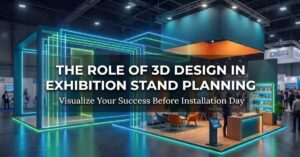
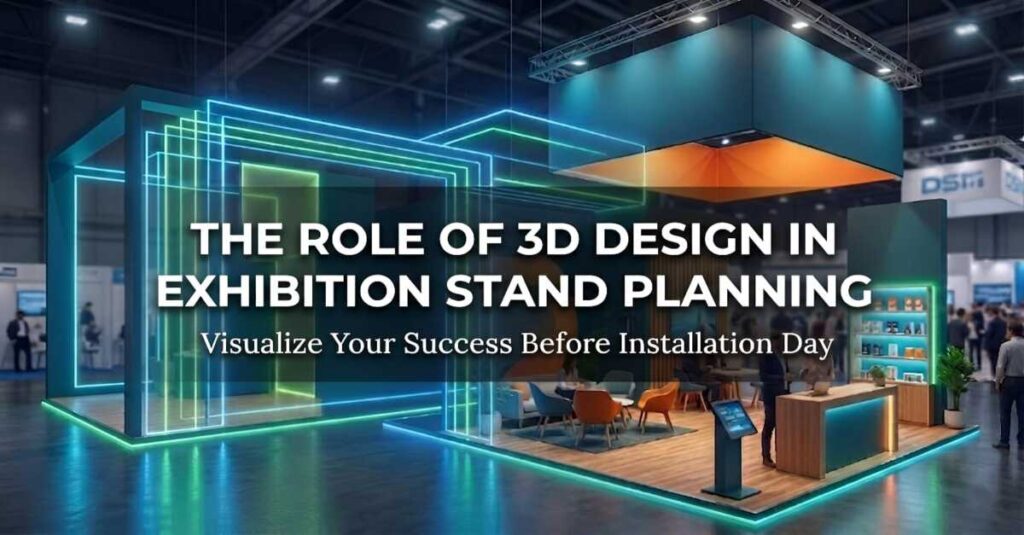
A 3D render is a photorealistic digital visualization of your exhibition stand, produced using professional design software before a single panel is fabricated or a single graphics is printed.
Unlike a floor plan (which shows only dimensions and layout from above)or a rough sketch (which gives a loose impression), a 3D render shows you:
- Exactly how the stand looks from the visitor’s perspective at ground level
- How lighting interacts with surfaces, graphics, and structure
- The true scale of signage, displays, and branding elements
- How products look within the space
- How the stand relates to the surrounding floor environment
- The relationship between different zones, reception, product display, meeting area, storage
A 3D render lets you see your stand before it exists. And that changes everything.
What to Expect From Limelite’s 3D Design Process
When you work with Limelite on an exhibition stand, our 3D design process follows a clear structure:
Discovery Briefing: We gather all brand guidelines, floor plan dimensions, product details, and exhibition objectives.
Initial Concept Development: Our designers produce multiple creative directions in 3D from the brief.
First Render Presentation: you receive photorealistic renders from multiple angles, including visitor eye level and aerial overview.
Feedback and Revision: We incorporate your changes and present revised renders for review.
Final Sign-off: Once approved, the confirmed 3D model becomes the production blueprint.
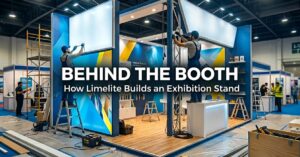
Build and Deliver: Fabrication and installation are executed exactly as per the approved render.
Typically this process involves two to three rounds of feedback before final approval, though the number of revisions depends on the complexity of the stand.
See Your Stand Before It’s Built
A 3D render is not an extra step in the design process. It is the most important step. It protects your investment, aligns your team, improves the creative output, and ensures that what arrives on installation day is exactly what you envisioned.
At Limelite, every stand we design includes full 3D visualisation as standard. Because we believe you should never have to imagine what your stand will look like. You should be able to see it.